
AI-powered platform for food extrusion

    Meallions OS platform forfood manufacturing.

    From R&D to intelligent production.

    Built with manufacturers, equipment OEMs and universities

    PROCESS MNEMONIC · P&IDExtruder extruder-int-001 — twin-screw, 6 zones, 5 feeders · LINE-A / EXT-001FEEDER 1RICE FLOUR68.4WIF-101FEEDER 2SOY PROTEIN14.3WIF-102FEEDER 3STARCH9.57WIF-103FEEDER 4SUGAR4.37WIF-104FEEDER 5SALT MIX1.20WIF-105MOTORM-101GEARBOXG-101INTAKELEVEL 60%WI-201H₂O12.6 kg/hV-301VACTWIN SCREWTI211Zone 1 · FEEDCOOLHEAT42.9°CTI221Zone 2 · CONDCOOLHEAT86.0°CTI231Zone 3 · PLASTCOOLHEAT122.3°CTI241Zone 4 · VENTCOOLHEAT147.2°CTI251Zone 5 · MIXCOOLHEAT164.0°CTI261Zone 6 · METERCOOLHEAT151.2°CDIE HEADPT401149.8 °CCUTTER102.4 RPM→ PRODUCTCV-501SCREW SPEED85.9 RPMTORQUE3.2 AMotor OnFeeder OnCutter On
    Meallions OS

    From Recipe Design to Intelligent Production.

    Meallions OS connects the entire food manufacturing ecosystem in one governed workflow—bringing together product requirements, formulation knowledge, process simulation, equipment behavior, verification, and production data.

    It turns what teams learn in research and on the line into better decisions for the next recipe, the next run, and every connected production site. Experts stay in control while AI handles the repeatable work of moving from intent to production-ready action.

    The core process

    AI at the core of the platform.

    01Shared knowledge base

    Research + Learning

    Shared knowledge base of verified research, ingredients, machinery, and connected-site production.

    • Combines verified research, ingredient, nutrition, machinery, and connected-site production.
    • Every new project and connected production site strengthens the shared knowledge base.
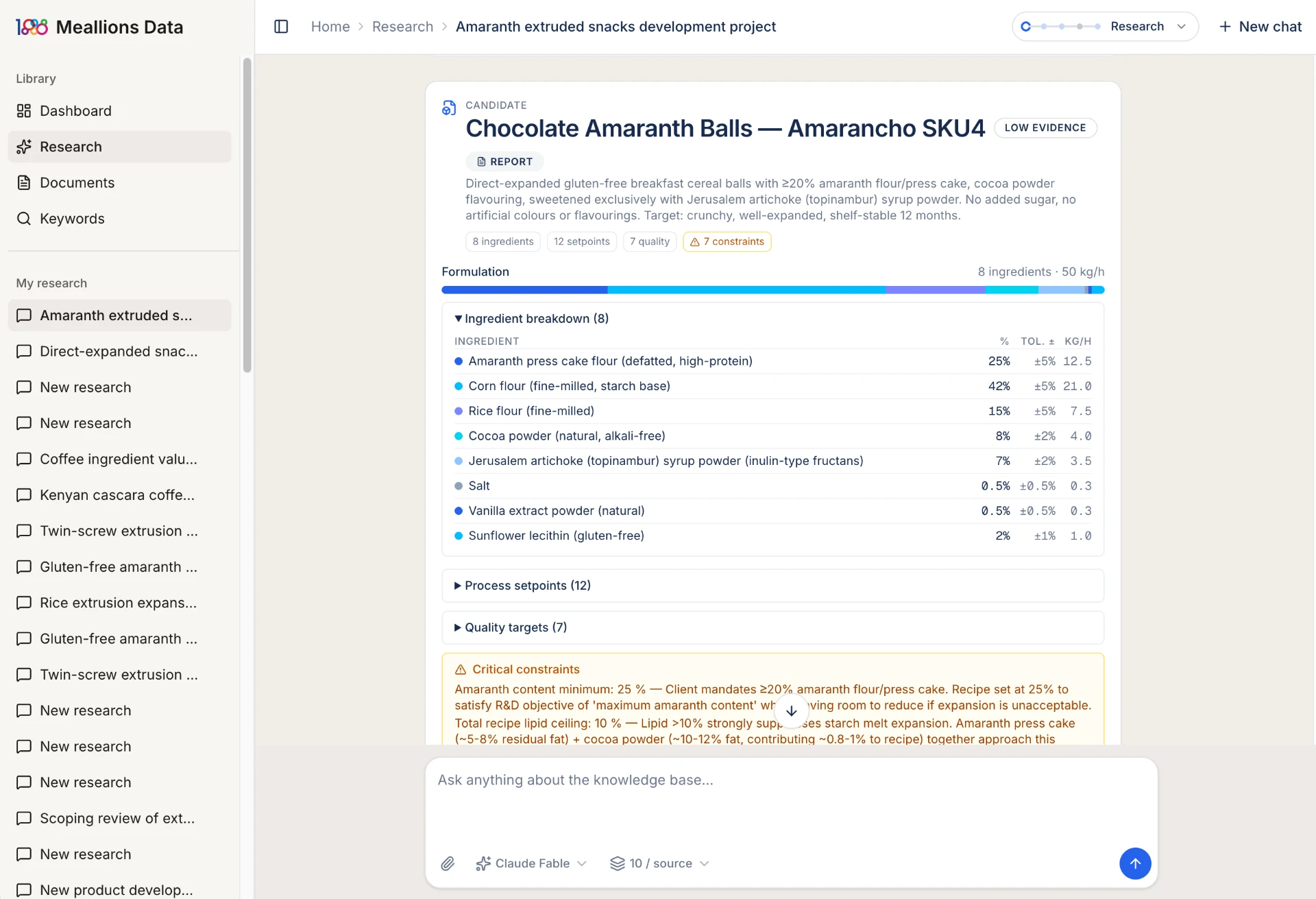
    Research workspace · grounded formulation candidate

    Every project and site strengthens the platform.

    Time and money savings

    The old way vs. the digital twin.

    Meallions OS moves repeatable R&D work into a subscription platform, so experts spend production line time verifying a better starting point.

    01

    Research

    Traditional

    2–4 weeks

    Digital twin

    2–5 hours

    Cost impact

    Up to 95% lower cost

    Start with a ranked, sourced hypothesis.

    No blank-page research.

    02

    Recipe

    Traditional

    1–8 weeks

    Digital twin

    1–2 days

    Cost impact

    Up to 92% lower cost

    Rank candidates against technical, nutrition and cost constraints.

    Iterate with BOM and nutrition together.

    03

    Simulation

    Traditional

    2–6 weeks

    Digital twin

    1–3 hours

    Cost impact

    Up to 97% lower cost

    Evaluate twin-screw behavior before scale-up.

    Resolve more before committing line time.

    04

    Production

    Traditional

    4–9 weeks

    Digital twin

    2–4 days

    Cost impact

    Up to 50% lower cost

    Start the line from evaluated parameters.

    Confirm instead of discovering.

    05

    Release

    Traditional

    1–3 weeks

    Digital twin

    1–2 hours

    Cost impact

    Up to 83% lower cost

    Check the approved result against its targets.

    Decision history stays connected.

    Cost reductions are measured against a conventional development programme for the same product on the same equipment. The savings above 90% apply to research, formulation, simulation and release documentation, where verified knowledge and digital-twin runs replace repeated physical trials. The physical production run is capped near 50%: material, energy, labour and line time remain real costs, and the saving comes from fewer failed runs, less scrapped material and shorter commissioning. Actual figures are confirmed per pilot against the customer's own baseline.

    Why specialization matters

    Better grounding creates better starting points.

    General AI can help explain a problem. Meallions OS helps teams work through specific food-manufacturing decisions by connecting verified evidence, source priority, technical constraints, equipment context, process methodology, and production feedback.

    • Faster R&D to scale

      Move from research through digital validation and line trials to controlled scale-up.

      Time to scale

    • Lower total cost

      Optimize raw-material cost, energy, yield, and waste while protecting quality.

      Cost/kg and energy/kg

    • Consistent product quality

      Respond earlier to ingredient variability and emerging process drift.

      Yield and variation

    • Operator and QA control

      Maintain human approvals, confidence thresholds, overrides, and audit-ready records.

      Deviations and overrides

    • Ecosystem intelligence

      Every project and production site improves shared recipes, models, and operating decisions.

      Ecosystem improvement and ramp time

    Verified Sources

    Verified Sources

    Every answer is grounded in sources we've checked, and you can see them.

    From indexed articles to Verified Sources

    A four-stage funnel: indexed articles are screened, each remaining source is checked, and the result is the Verified Sources knowledge base.

    1. 01

      Indexed articles

      The full corpus collected from domain publications, journals and trusted outlets.

      N articles

    2. 02

      Screened

      Duplicates, low-quality and off-topic material removed.

      N articles

    3. 03

      Source check

      Each source is assessed for authority, recency and consistency with other sources.

      N sources

    4. 04

      Verified Sources

      The curated knowledge base the platform answers from.

      N sources

    How sources are rated

    Each source gets a reliability rating based on the authority of the publisher, its recency, and its agreement with other Verified Sources. Higher-rated sources carry more weight in answers.

    How you can check every conclusion

    Every key statement in an answer comes with an inline citation. Clicking it opens the original article via a direct link, so you can verify the claim yourself.

    Example answer

    Higher barrel moisture typically lowers expansion in extruded cereals[1].

    [1] Source title placeholder

    Verified · High

    Publisher name · Publication date

    Open source

    Verified Sources vs. general-purpose AI chatbots

    • Prepared knowledge corpus

      Meallions: Curated, domain-specific corpus

      General-purpose AI: Broad web training data, not curated

    • Source verification

      Meallions: Every source checked and rated, cited in answers

      General-purpose AI: Sources usually not verified or shown

    • Domain specialization

      Meallions: Built for food manufacturing and food extrusion

      General-purpose AI: General knowledge across all topics

    Frequently Asked Questions